Quick answer
Should a Mohali business hire an in-house developer or work with a software company?
In-house developer vs software company in Mohali comes down to how much work you have and how many skills it needs. One developer suits steady, small daily changes. A software company suits new builds that need design, coding, testing, cloud and support together. Many growing businesses use both: a company to build, and one staff member to manage it.
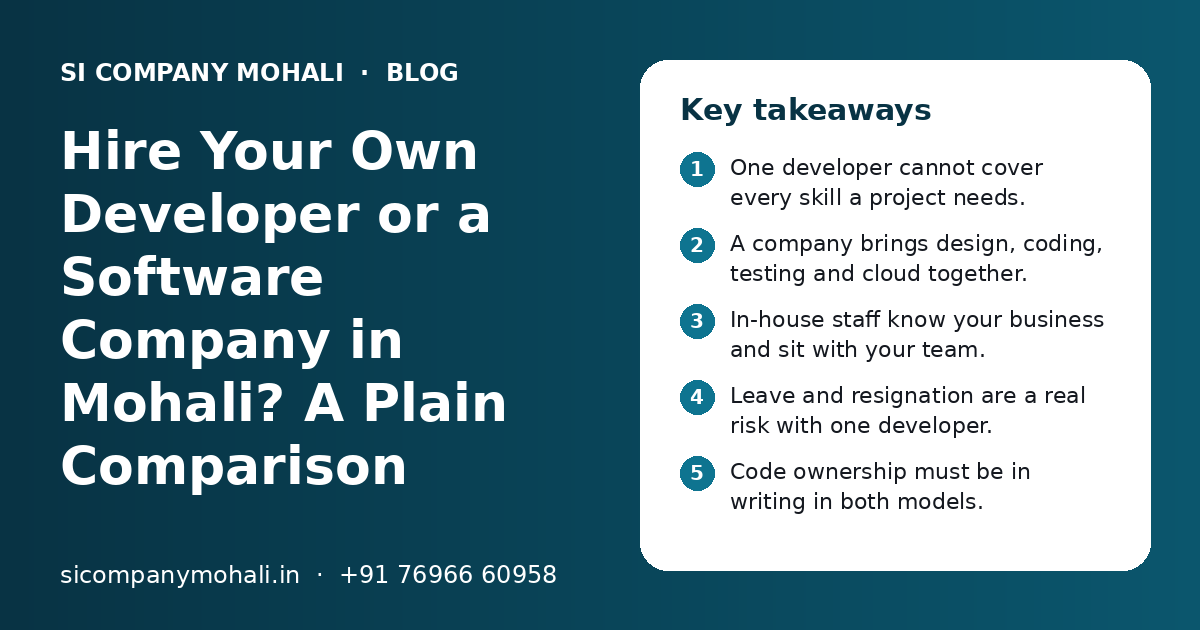
Key takeaways
- One developer cannot cover every skill a project needs.
- A company brings design, coding, testing and cloud together.
- In-house staff know your business and sit with your team.
- Leave and resignation are a real risk with one developer.
- Code ownership must be in writing in both models.
- A hybrid model often suits growing Tricity businesses.
What is the real choice between an in-house developer and a software company?
The real choice is between one or two people on your payroll who work only for you, and a team you hire for a project or a support plan. Both can work well. The right answer depends on your work, not on what others do.
In the in-house developer vs software company Mohali question, owners often think only about salary versus quote. That is a small part of it. Skills, risk, speed, ownership and support matter just as much.
A trading firm in Phase 8 Industrial Area, a coaching centre in Kharar and a clinic in Zirakpur may each need a different answer.
What affects the cost of each option?
With your own developer, cost is mostly a monthly salary that runs whether there is work or not. With a software company, cost is linked to the scope you agree. The total cost of each depends on more than the headline figure.
Cost factors for an in-house developer
- Monthly salary, plus yearly increments.
- PF, ESI where it applies, bonus and leave pay.
- Laptop, software licences, internet and desk space.
- Time and money spent to find, interview and train the person.
- Paid cloud tools, test devices and app store accounts.
- Cost of hiring again if the developer resigns.
Cost factors for a software company
- Number of features, user roles and screens.
- Integrations like WhatsApp, payment gateways, Tally or GST tools.
- Whether you need a web app only, or Android and iOS apps too.
- Design work, data migration and staff training.
- Hosting, support and updates after launch (often called AMC).
- GST on the invoice, which a registered business may claim as input credit.
A simple way to compare is to look at one year. Add up everything your own developer would cost for twelve months. Then compare it with the build cost plus one year of support from a company. Our page on software development cost in Mohali explains the main cost drivers in more detail.
In-house developer vs software company: how do they compare side by side?
A software company wins on skills range, backup and speed of a new build. An in-house developer wins on daily access and deep knowledge of your business. The table shows the main points.
| Point | In-house developer | Software company |
|---|---|---|
| Skills | Usually strong in one or two areas | Designers, developers, testers and cloud people in one place |
| Speed of a new build | Slower, one person does everything | Faster, work runs in parallel |
| Leave and resignation | Work stops when the person is away | Another team member can step in |
| Knowledge of your business | Grows every day | Needs good briefing and documents |
| Daily small changes | Quick, the person sits nearby | Handled through a support plan or tickets |
| Testing | Often self-tested | Separate testing step is common |
| Management effort | You manage the person and the work | You manage the vendor and the scope |
| Cost pattern | Fixed monthly cost | Linked to scope or a support plan |
| Code ownership | Belongs to you if the job contract says so | Belongs to you if the agreement says so |
| Best for | Steady, ongoing in-house tools | New products, bigger systems, many skills |
A business building a customer app, a CRM and a web portal together usually needs a team.
Can one developer cover all the skills your software needs?
Usually not. Most business software needs design, front-end, back-end, database, testing, cloud and security skills, and very few people are strong in all of them.
A good developer may be very strong at back-end code but weak at screen design. Another may build good-looking screens but have little server experience. When one person must do all of it, some parts end up weak. Often it is testing, security or backups, because those are easy to skip when deadlines are close.
A company like ours has these skills in one team. Our parent team, Shivah Web Tech, has a 25+ member in-house team in Mohali and has worked on 500+ projects over 11+ years. When we take on software development in Mohali, each part goes to the person who does it best.
Need help with your project?
Talk to the SI Company Mohali team. Free first call, simple advice, clear quote.
What happens when your only developer takes leave or resigns?
When your only developer is away, changes stop and urgent problems wait. When they resign, the knowledge in their head can leave with them unless it is written down.
This is the biggest risk of the one-developer model. A developer may fall ill, take long leave or get a new job offer. A new person needs time to learn your system.
How to reduce this risk with an in-house developer
- Keep all code in a company-owned Git account, not a personal one.
- Keep server, domain, cloud and app store logins in the company name.
- Ask for short written notes on how the system is set up.
- Make sure the database is backed up daily to a place you control.
- Have a second person, or an outside company, who knows the basics of the system.
- Write a handover step into the job contract and the notice period.
With a software company, leave and resignation are the company's problem to manage. A good firm keeps code, notes and access in shared systems, so another team member can pick up the work. Still, ask how they handle staff changes before you sign.
Who owns the code in each model?
In both models, you should own the custom code you pay for, but only a clear written agreement makes that certain. Do not assume ownership just because you paid.
With an employee, the job contract should say that the work they create for the business belongs to the business. With a company, the project agreement should say that ownership of custom code moves to you after agreed payment, and list what is handed over.
- 1
Put ownership in writing
Add a clear clause in the job contract or the project agreement before any work starts.
- 2
Use your own accounts
Create the Git, hosting, domain and app store accounts in the business name and give access to the developer or company.
- 3
Ask for regular code updates
Make sure the latest code is pushed to your account every week, not only at the end.
- 4
Collect documents and logins
Keep setup notes, database access and admin logins in one safe place you control.
- 5
Check at handover
Before the last payment or the last working day, confirm you have everything listed in the agreement.
We have written a full guide on this topic: who owns the source code of custom software. It lists what to ask for at handover.
Which option gives better support after the software goes live?
A software company usually gives more dependable support because it has more people and set response rules. An in-house developer gives faster help for small daily issues, as long as they are available.
Ask how each option will handle a broken payment link on a Saturday or a full server at month end.
Support from your own developer
- Quick answers to small questions during office hours.
- Knows how your staff use the system day to day.
- Can sit with a user and fix a problem on the spot.
Support from a software company
- Needs a support plan or ticket system to work well.
- Small changes may wait in a queue if the plan is not clear.
- Needs good communication on WhatsApp, phone or email.
The right support plan fixes most of these gaps. Our IT support in Mohali covers software, cloud servers, email and backups, with clear response rules. Our parent team works Mon–Fri 9:30–6:30 IST and offers 24x7 emergency support for urgent issues.
Before go-live, it also helps to run through our software go-live checklist, whichever model you choose.
What is the hybrid model, and when does it work best?
In the hybrid model, a software company builds and runs the main system, and one person in your team manages it day to day. It works well for growing businesses that need both outside skills and inside knowledge.
Company builds
New modules, apps, integrations and cloud setup are done by the company team.
Staff member manages
User training, small settings, reports and first-level questions stay in-house.
Shared code account
All code sits in your company-owned account, so both sides can see it.
Regular review
A short monthly call to plan the next changes and check open issues.
This model suits many businesses on the Airport Road, in Sector 82 or around Kharar and Zirakpur that are past the starting stage but not large enough for a full IT department. We serve Kharar and Zirakpur from our nearby Mohali office, and you can read more on our software company in Kharar page.
How do you decide between an in-house developer and a software company?
Start with the work, not the people. List what you need built, what skills it needs and how much ongoing change you expect, then pick the model that covers it with the least risk.
- 1
Write down the work
List the software you need now and in the next year: new builds, daily changes, reports and integrations.
- 2
Mark the skills needed
Note which tasks need design, mobile apps, cloud, security or integrations.
- 3
Estimate the ongoing load
Ask whether there will be steady work every week, or a big build followed by small changes.
- 4
Compare one year of cost
Add salary and hidden costs for a developer, and build plus support for a company.
- 5
Check the risks
Think about leave, resignation, code ownership and backup for each option.
- 6
Talk to both sides
Interview a developer and speak to a software company before you decide.
- 7
Start small
Begin with a first version or a short trial, then review after a few months.
Quick guide
| Your situation | Usually fits |
|---|---|
| One internal tool, small steady changes | In-house developer |
| New customer app, portal or CRM | Software company |
| Many skills needed at once | Software company |
| Large system with daily change requests | Hybrid model |
| Not sure what you need yet | Talk to a consultant first |
If you are still unsure, a short session with our technology consulting team can help. We will tell you honestly if one developer is enough for your needs.
Frequently Asked Questions
Is it cheaper to hire a developer or a software company in Mohali?
It depends on how much work you have. A developer costs the same every month, even in quiet months, plus PF, equipment and hiring time. A company charges for the agreed scope or a support plan. For a single build followed by small changes, a company is often more cost-effective. For heavy daily work, a developer may cost less. Compare one full year of costs before you decide.
Can a small business in Kharar or Zirakpur manage with one developer?
Yes, if the work is small and steady, like one internal tool with regular changes. Make sure the code, server and domain accounts are in the business name, and keep written notes on how the system works. For apps, portals or systems that need many skills, one developer usually struggles. We serve Kharar and Zirakpur from our nearby Mohali office if you need extra help.
What should I do if my in-house developer leaves suddenly?
First, secure access. Change passwords for the server, domain, cloud, email and app store accounts. Check that the latest code is in a company-owned account. Ask the developer for handover notes during the notice period. Then bring in another developer or a software company to study the system and take over support. Doing this early avoids long breaks in your business.
Do I own the code if a software company builds my software?
You own the custom code if your written agreement says so. Ask for a clause that moves ownership to you after the agreed payment. The agreement should also list what you receive at handover: source code, database, logins and documents. Some ready-made parts may come under their own licences, so ask the company to list them clearly.
What is a hybrid software team?
A hybrid team mixes an outside software company with one or more of your own staff. The company builds new features and handles servers, security and complex work. Your staff member handles user questions, small settings, reports and testing. This gives you outside skills and inside knowledge together, without the cost of a full in-house IT department.
Should I talk to a consultant before hiring a developer or a company?
If you are not sure what you need, yes. A short consulting session helps you list the work, the skills it needs and the likely risks. You then know whether one developer is enough or whether you need a team. It also helps you write a clear brief, which leads to better quotes and fewer surprises later.