Quick answer
What is an MVP and should my startup build one first?
An MVP, or minimum viable product, is the smallest working version of your product that solves one main problem for real users. For most startups in Mohali, building an MVP first is the right choice. It costs less, launches faster and shows you what users really want before you spend on the full product.
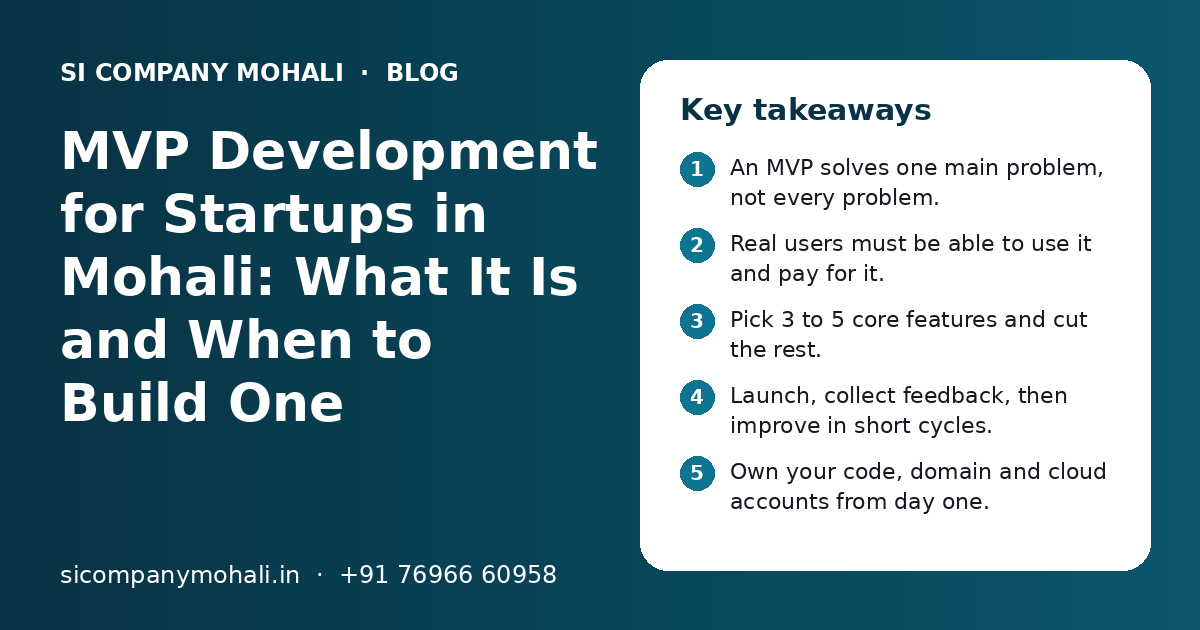
Key takeaways
- An MVP solves one main problem, not every problem.
- Real users must be able to use it and pay for it.
- Pick 3 to 5 core features and cut the rest.
- Launch, collect feedback, then improve in short cycles.
- Own your code, domain and cloud accounts from day one.
What is an MVP in software?
An MVP is the first small version of a product that real people can use to solve one clear problem. It is not a demo or a slide deck. It is working software, but with only the features that matter most.
Think of a food delivery idea. The full product may have live tracking, loyalty points, chat, ratings and many payment options. An MVP may only have a menu, an order form, UPI payment and a WhatsApp message to the restaurant. If people order through it every day, the idea works. Then you add more.
The word "viable" matters. If the MVP is broken or confusing, you learn nothing useful. Small does not mean careless.
Should my startup build an MVP first?
Yes, in most cases. If you are not yet sure who will pay, what they need most, or how they will use the product, an MVP is the safest first step.
Founders in Mohali, Kharar, Zirakpur and Chandigarh often have a strong idea but a limited budget. Spending that budget on a big product that nobody uses is the biggest risk. An MVP lowers that risk. You spend a part of the money, learn fast and decide the next step with real data from your own users.
When an MVP is the right choice
- You are testing a new idea or a new market
- You want to show investors something that works
- You need early users to give feedback
- Your budget is limited and you want to spend in stages
- You are not sure which features matter most
When you may need more than an MVP
- You are replacing a system your staff already use every day
- Rules or contracts require a full set of features at launch
- You are entering a crowded market where users expect a polished product
- The core feature itself is large, such as a payments or medical system
MVP vs prototype vs full product: what is the difference?
A prototype shows how the product will look, an MVP lets real users do the main job, and a full product covers all jobs for all users. Each has a different purpose and a different cost.
| Point | Prototype | MVP | Full product |
|---|---|---|---|
| Main purpose | Show the idea and the screens | Test if users really use and pay | Serve a large user base well |
| Does real work? | No, it is only clickable design | Yes, for one main job | Yes, for many jobs |
| Who uses it | Founders, investors, a few test users | Early users and first customers | All customers and staff |
| Features | Screens only | 3 to 5 core features | Many features, settings and reports |
| Time to build | Shortest | Medium | Longest |
| Cost | Lowest | Moderate | Highest |
Many startups do both. First a clickable prototype to check the flow with ten or twenty target users. Then an MVP built on that feedback. This saves time because the developers build the right screens the first time. Our web application development team often starts this way.
Which features should go into an MVP?
Only the features that are needed for a user to complete the main job from start to end. Everything else goes on a later list.
A simple way to decide is to write one sentence: "Our product helps [user] to [do one job] without [main pain]." Every feature must help that sentence. If it does not, it waits.
- 1
Write the problem in one line
Name the user and the one job. For example, "helps a coaching centre in Kharar collect fees on time without calling every parent."
- 2
List every feature idea
Write all ideas from the team, investors and early users. Do not judge them yet.
- 3
Mark must, should and later
Must means the main job fails without it. Should means it helps a lot. Later means it is nice to have.
- 4
Keep only the must list
Most good MVPs have 3 to 5 must features. If your list is longer, look again.
- 5
Add the basics
Login, a simple admin panel, basic security and a way to collect feedback are always needed.
- 6
Write it down and agree
Put the final scope in writing with your development partner so nobody adds features in the middle.
How long does it take to build an MVP?
A focused MVP usually takes a few weeks to a few months. The time depends on the number of features, the number of user types, and whether you need web, Android and iPhone at the start.
We do not promise a fixed number of weeks before we see your scope. A simple booking or lead tool is much faster than a marketplace with buyers, sellers, payments and delivery. After a free call, you get a clear plan with stages and dates.
What makes an MVP take longer
- Many user types, such as customer, vendor, delivery staff and admin
- Payments, refunds and payouts to many parties
- Native mobile apps for both Android and iPhone from day one
- Links with other systems such as accounting, maps or government portals
- Changing the scope after the build has started
If your product must be a phone app from the start, our mobile app development team can build one codebase for Android and iPhone using Flutter. This often saves time compared with two separate apps.
Need help with your project?
Talk to the SI Company Mohali team. Free first call, simple advice, clear quote.
What affects the cost of MVP development?
The cost depends mainly on scope: the number of features, user types, platforms and integrations. Design quality, security needs and support after launch also matter.
We do not publish fixed prices, because two MVPs with the same name can be very different. You get a clear quote after a free call. Our software development cost guide explains these factors in more detail.
| Cost factor | Lower cost when | Higher cost when |
|---|---|---|
| Number of features | 3 to 5 core features | Many features at launch |
| User types | One or two types | Customers, vendors, staff and admin |
| Platforms | Web app only | Web plus Android and iPhone apps |
| Design | Clean standard design | Custom design with many animations |
| Payments | Simple UPI or card payment | Split payments, wallets and payouts |
| Integrations | None or one | Many outside systems and APIs |
| Data and security | Basic user data | Health, finance or other sensitive data |
| Support | Bug fixes for a short period | Ongoing new features and monitoring |
Should a startup use no-code tools or custom code for an MVP?
No-code tools are fine for a very early test with a few users. Custom code is better when you plan to grow, need your own data rules, or want investors to see a real product you own.
No-code MVP
- Very fast for simple forms and lists
- Good for testing demand with a few users
- Founders can change small things themselves
Limits of no-code
- Monthly fees grow as users grow
- Hard to add custom logic or special workflows
- Moving to custom code later often means a rebuild
- Your data and logic sit inside another company's tool
Custom code takes a little more time at the start. But the product is yours. You can change any part, host it on your own cloud account and grow it step by step. A common stack is Laravel or Node.js for the backend and React for the screens, hosted on a cloud server. Our cloud solutions team sets up hosting that can grow with your users.
If your idea is a subscription product for other businesses, read our page on SaaS development. It covers multi-tenant setup, plans and billing, which shape the MVP from the first day.
What happens after the MVP is launched?
After launch, you watch how users behave, talk to them, fix problems and plan the next release. The MVP is the start of a cycle, not the end of the project.
- 1
Track a few key numbers
Sign-ups, how many users finish the main action, and how many come back the next week.
- 2
Talk to users
Call or WhatsApp early users. Ask what was hard, what was missing and what they liked.
- 3
Fix the top problems
Sort bugs and complaints by how many users they affect. Fix the biggest first.
- 4
Plan the next release
Move a few items from the later list into the next small release.
- 5
Repeat
Release, learn and improve in short cycles.
Many products later need links with other tools. For example, sending order updates on WhatsApp or syncing with accounting software. Our API integration and WhatsApp API integration teams add these when the time is right, without changing the core product.
What mistakes should startups avoid when building an MVP?
The biggest mistakes are building too much, skipping user feedback and not owning your own code and accounts. Each one wastes time and money.
- Adding every feature. Each extra feature delays launch and adds bugs.
- Building in secret for months. Show designs and demos to real users early.
- No clear success measure. Decide before launch what result means the idea works.
- Picking the cheapest quote only. A poor MVP can cost more to fix than to rebuild.
- Not owning the code. The code repository, domain, cloud and app store accounts should be in your company's name. Read who owns software source code for more.
- No plan after launch. Keep some budget and time for fixes and the second release.
How does SI Company Mohali help startups build an MVP?
We help founders turn an idea into a focused MVP, build it with our in-house team and support it after launch. We work with startups in Mohali and serve Kharar, Zirakpur and Chandigarh from our nearby Mohali office.
SI Company Mohali is powered by Shivah Web Tech, with 11+ years of experience, a 25+ person in-house team and 500+ projects. The parent team is Startup India recognised and MSME registered, so we understand the stage you are in.
Not sure where to start? Our technology consulting team can review your idea and suggest the right first step. If you are near Kharar, see our software company in Kharar page. Or simply contact us for a free call. Office hours are Monday to Friday, 9:30 to 6:30 IST.
Frequently Asked Questions
What does MVP stand for in a startup?
MVP stands for minimum viable product. It is the smallest working version of a product that solves one main problem for real users. Startups build an MVP to test their idea in the real world, learn what users want and decide what to build next, without spending the full budget at the start.
Is an MVP worth it for a small startup in Mohali?
Yes, for most small startups an MVP is worth it. It lets you launch sooner, spend in stages and learn from real users before building more. Founders in Mohali, Kharar and Zirakpur often have limited budgets, so testing the idea first with a focused product is usually a safer choice than building everything at once.
How much does MVP development cost in India?
The cost depends on the number of features, user types, platforms, payments, integrations, design and support after launch. A web-only MVP with a few core features costs far less than a web and mobile product with many user types. We do not publish fixed prices. You get a clear quote after a free call about your scope.
How many features should an MVP have?
Most good MVPs have 3 to 5 core features, plus basics like login, a simple admin panel and security. The rule is simple. Keep only the features a user needs to finish the main job from start to end. Put every other idea on a later list and add it after you learn from real users.
Should my MVP be a web app or a mobile app?
A web app that works well on mobile browsers is often the fastest and cheapest start. It needs no app store approval and works on any phone. Choose a mobile app first if your product needs the camera, location, offline use or frequent notifications. Flutter can build one app for both Android and iPhone.
Can I build an MVP with no-code tools instead?
You can, for a very early test with a few users and simple features. No-code tools are fast but have limits. Monthly fees grow with users, custom logic is hard and moving to custom code later often means a rebuild. If you plan to grow or raise funds, a custom-coded MVP you fully own is usually better.
Who should own the code of my MVP?
Your company should own the code. Ask for the code repository, domain, cloud hosting account and app store accounts to be set up in your company's name from day one. Get this written in the contract. This keeps your product safe if you ever change your development partner or bring the work in-house later.
What happens if users do not like my MVP?
That is useful news, not a failure. The MVP did its job by showing you early, before you spent the full budget. Talk to users to learn why. You may need to change the main feature, the target user or the pricing. Many products succeed after one or two changes made from real MVP feedback.